A Question Walk Around a Familiar Block
A question walk around a familiar block helps you compare one feature from different sidewalk viewpoints and keep a clear record of what each view reveals.
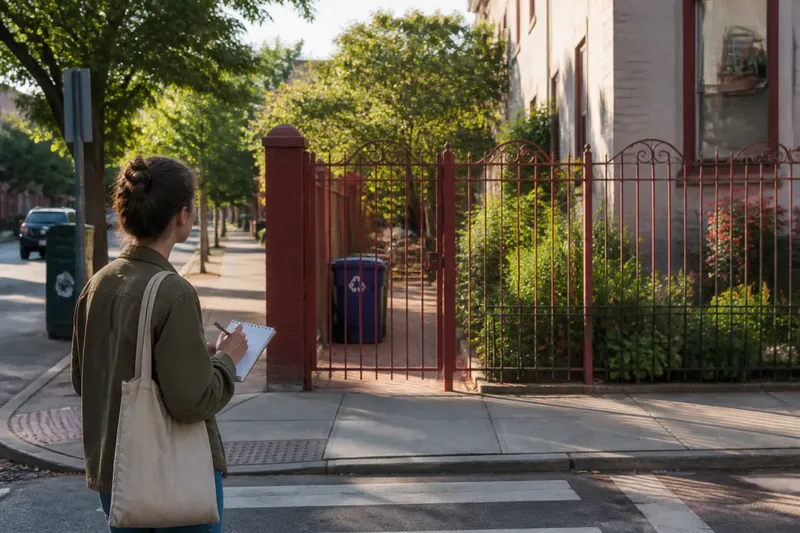
A question walk around a familiar block can reveal how much a single feature changes as you pass it. Choose a street tree, gate, or shop window, then compare its view from several safe places along a route you already know.
Use the route
Let an ordinary errand supply the route: the sidewalk to the corner store, a loop around your block, or the walk from a bus stop. The familiar path makes it easier to focus on the sequence of views instead of finding your way.
Pick a feature visible from public space. Note three or four places where you can pause without blocking the sidewalk, such as a corner, a spot beside a public bench, or a driveway crossing. Keep out of traffic, private property, planted beds, and restricted areas. If any viewpoint feels unsafe, skip it.
The route is part of the exercise. Each stop offers a position in a sequence: approaching, passing, and looking back. Like turning a small object in your hand, changing your position can reveal a new edge without changing the object itself.
Frame the sequence
Ask one question that can be answered by looking from each stop. For a tree, ask, “Which parts of the trunk can I see from each corner?” For a shopfront, ask, “What overlaps the window as I approach from either direction?” Keep the wording tied to visible details rather than a cause you cannot establish by looking.
Use the same question at every point. If a sign hides the lower trunk from one corner, note that view; if the trunk appears clear from the next, note that too. This route-based comparison makes the order of the views as useful as the details themselves.
Mark each viewpoint
Give every stop a landmark you can recognize again: “by the bus stop,” “opposite the laundromat,” or “at the east corner.” A short route rarely needs a map, but clear place names help you connect each note to its position.
At each stop, pause and look before writing. Notice outlines, overlaps, gaps, and what enters or leaves the frame as you move. If a parked car blocks the view at one point, record that condition rather than changing your route to get closer.
Keep your attention on the surroundings as well as the feature. Step aside for other pedestrians, and do not write while crossing a street. If stopping to take notes would distract you, wait until you reach a quiet, safe place.
Record the route
Write the question first, then add a short line for each landmark. Include the location and what was visible there. A pocket notebook works well; a phone note does too, as long as the stops remain in order.
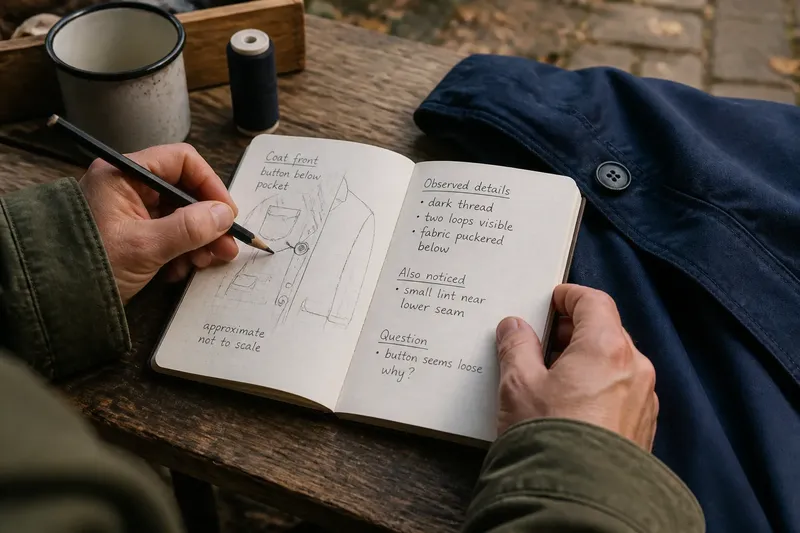
Keep what you saw separate from what you think it means. “A dark patch lies beneath the window” is an observation; “the wall is damp” is an interpretation. If you want to keep the idea, mark it as a possibility rather than folding it into the description.
- Check that the question names something visible; if it asks why something happened, reword it as a question about what appears from each stop.
- Check that every stop has a recognizable landmark; if not, add a nearby corner, sign, or public bench, or choose a clearer stopping point.
- Check whether the feature is visible from the sidewalk; if it is not, select another feature rather than entering a restricted or private place.
- Check for overlaps, gaps, and edges at each stop; if none stand out, write that the view appears unchanged and compare the next point.
- Check whether a temporary obstruction or shade affects the view; if it does, note it beside that stop, or leave it out if it does not alter what you can see.
- Check that each note describes an appearance rather than a cause; if it states a cause, rewrite it as a visible detail and keep the explanation marked as uncertain.
Imagine you are walking to a corner store and choose a red metal gate as the feature. Your question is, “What can I see through the bars from each stop?” From the near corner, you note a recycling bin lined up with an opening; opposite the gate, you see a strip of garden; beside the next corner, the bars frame only small patches. Your route record shows three different views, while making no claim that the gate or garden changed.
What should I ask?
How many stops should I choose?
Choose enough distinct sidewalk viewpoints to compare the feature, but keep the route easy to walk. If two stops give nearly the same angle, move to a safer nearby landmark or leave one out.
Should I take a photo?
A photo is optional; a few words may better capture the overlap or gap that matters to your question. If you take one, keep people’s privacy in mind and avoid pointing the camera into private spaces.
What if the views look alike?
Record that the visible details stayed much the same across the route. You can finish with that result or choose a feature with a more varied outline on another walk.
Can I compare another day?
Yes. Keep the same landmarks and question so you can compare what appears from each position on a later walk. Note any different obstruction or viewing condition, and treat the difference as something to examine rather than proof of its cause.
Finish with comparison
At the last stop, read the notes in route order and write one sentence comparing the first view with the last. For example, say the sign covered the lower trunk near the bus stop but not from the east corner. That sentence preserves the route’s main observation without turning it into an explanation.
A question walk around a familiar block works best as a record of where you stood and what each position let you see. Keep the route landmarks with the notes; they make the changing views easier to revisit, even when your interpretation remains open.