How to Check Your First Explanation
Check your first explanation by recording what you can actually observe, comparing plausible alternatives, and choosing a useful next question without overreaching.
When a familiar object seems to tell an obvious story, write down what you noticed before deciding what caused it. Checking your first explanation starts with details you can point to, not a polished theory. A chipped mug, for instance, has a pale mark along its rim; “someone dropped it” is a separate claim.
First impressions
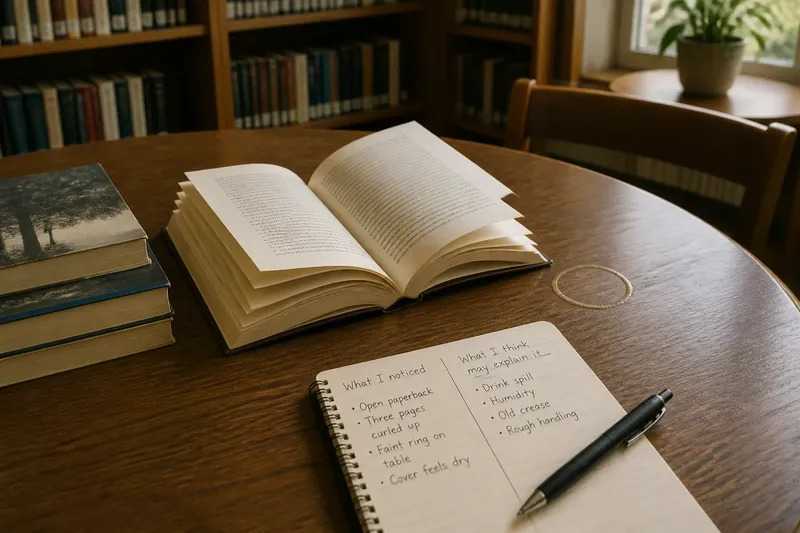
Imagine you find a paperback on the library table with its pages curled. You might think someone left it beside a drink. But the visible facts are narrower: the book is open, several pages bend upward, and a faint ring marks the table nearby. The ring may be connected—or it may belong to an earlier visitor.
Write the scene in plain language before adding a cause. “Open paperback, curled pages, faint ring on table” is more useful than “book damaged by a spill.” It preserves the clues without deciding what they mean.
Separate the clues
An observation is something a careful person could see, hear, or read in a record. An inference is an explanation built from observations. “The pages feel stiff” is an observation; “they dried after getting wet” is an inference.
Be precise about time, too. If you did not see the book arrive, do not write “it was left here today.” You can say, “I noticed it on the table after lunch.” That wording describes your knowledge without pretending to know the book’s history.
A small notebook or phone note can help. Use two lines: “What I noticed” and “What I think may explain it.” Like sorting buttons by color before sewing, keeping the groups apart makes the next choice easier.
Compare plausible causes
List only explanations that fit the clues in front of you. For the paperback, moisture from a drink is one possibility. Humidity, an old crease, or rough handling might also explain curled pages. A useful alternative connects to something observable; a far-fetched possibility adds clutter rather than insight.
Ask what each explanation would lead you to expect. A recent spill might leave dampness or a visible mark on the book. An old crease may remain unchanged, while humidity could affect more than one nearby book. These are questions to guide attention, not proof that any cause is correct.
A worked comparison
Say you notice the paperback at a library table after lunch. Your starting notes are: the book is open, three pages curl upward, a faint ring sits beside it, and the cover feels dry. You first suspect a drink spill.
You then look without moving or damaging the book. The curled pages are dry, the ring does not overlap the book, and another nearby paperback also has curled pages. The drink explanation now fits less well than a shared room condition or an older crease. You still cannot identify the cause, but you have a better account to offer the librarian: two books have curled pages, the table ring is separate, and the covers feel dry. The result is a useful observation, not a diagnosis.
Questions for a closer look?
How can I spot an inference?
Check whether your sentence names a hidden cause, intention, or past event. If it does, mark it as a possibility unless you have direct evidence for it.
Should I keep my first guess?
Yes, but label it as a guess. Keeping it visible makes it easier to compare with other explanations instead of letting it quietly become a fact.
How many explanations are useful?
A few plausible options are usually enough to make a better next observation. Choose alternatives that account for the actual details, not every cause you can imagine.
When should I stop checking?
Stop if further inspection would damage someone’s property, invade privacy, or require access you do not have. In a shared space, describe what you noticed to the responsible person rather than taking the object apart or moving it without permission.
Choose the next question
Use your notes to decide what would distinguish the explanations. If the book is still at the table later, you might see whether the curled pages change; if another nearby book has the same pattern, that may be worth mentioning. Do not treat either observation as a complete answer.
- Notice a mark that overlaps the object; if it does, consider a direct connection, then look for another clue before deciding.
- Notice that the object is dry; if it is, set aside explanations requiring current moisture, then consider an older event or another cause.
- Notice similar changes on nearby objects; if they share the pattern, consider a shared condition, then compare one more object.
- Notice the change remains the same on a later visit; if it does, favor explanations involving an older or stable condition, then record the timing limit.
- Notice that checking requires moving or opening someone else’s property; if it does, stop and ask the owner or responsible staff member instead.
- Notice a clue that conflicts with your first guess; if it does, lower your confidence in that guess, then write down the competing explanation.
Checking your first explanation does not mean distrusting every instinct. It means giving the visible clues room to complicate a tidy story. A careful note can help the next person ask a better question, even when the cause remains unknown.