A Sketch or a List? Two Ways to Record What You Notice
Choose a sketch or list to capture the details you might otherwise forget, from an object's shape to the order of sounds, without slowing down.
A sketch or list helps you keep different parts of an observation: a sketch can show how a chipped mug’s handle meets its rim, while a list can capture the order of birds arriving at a feeder. The best choice depends on which detail you want to retrieve later, not on drawing skill.
Sketch for shape
Sketch when outline, position, or the relation between objects is hard to describe briefly. A few lines can show that a leaf rests across a sidewalk crack, with its stem pointing toward the curb. Add an arrow or a label if the relationship is not obvious.
Keep the drawing quick. One overall view or a small close-up is often enough to jog your memory. Use a pencil or pen that writes easily, and leave space beside the marks for a few words. The sketch is a reminder, not an artwork.
If proportions matter, mark the drawing as approximate and say what you can compare: “handle narrower than rim.” A sketch can make a rough shape look measured, so use an appropriate measuring tool when a dependable dimension matters.
List for sequence
Use a list for names, counts, sounds, repeated appearances, or anything with a meaningful order. “Two taps, pause, one tap” preserves a sound sequence more clearly than a drawing. Give each note a subject and a relation: “red thread caught on the lower hinge” is easier to understand later than “red thread.”
Short labels can help organize a page. Group notes under words such as “sound,” “surface,” or “position,” especially when you are comparing objects. If an entry does not fit the main question but still catches your attention, set it aside under “also noticed” rather than losing it in the main list.
Choose a recording format
- Check for a distinctive outline: if the shape is the detail you need, draw it; if not, describe the feature in words.
- Check whether placement matters: if several things relate spatially, sketch their arrangement; otherwise, name their positions in a list.
- Check for order or repetition: if events happen in sequence, list them in order; if the sequence is irrelevant, record only the notable event.
- Check whether color or texture matters: if it does, add plain words such as “blue-gray” or “rough edge” beside a sketch; if it does not, leave it out.
- Check whether words leave a gap: if a list cannot show the layout clearly, add a thumbnail map; if the sketch cannot preserve a sound or exact phrase, add a short note.
- Check whether the scene is changing: if a detail may disappear, record that detail first; if the scene is stable, take time to add context.
Think of a sketch as a tray holding objects in relation and a list as labeled jars holding separate details. The everyday analogy is simple: choose the container that keeps the part you want from spilling out.
What should you record first?
What if the scene changes quickly?
Record the detail most likely to vanish, such as a brief sound or a moving object’s direction. Add a simple sequence cue like “before” or “after” if order matters.
What if you cannot draw well?
Use basic shapes, arrows, and labels rather than trying to make a polished picture. A rough diagram that shows “beside” or “under” can carry the relationship clearly.
What if you need to compare objects?
Use the same prompts for each one, such as shape, surface, and position. Matching prompts make differences easier to spot without demanding identical drawings.
What if you are unsure what matters?
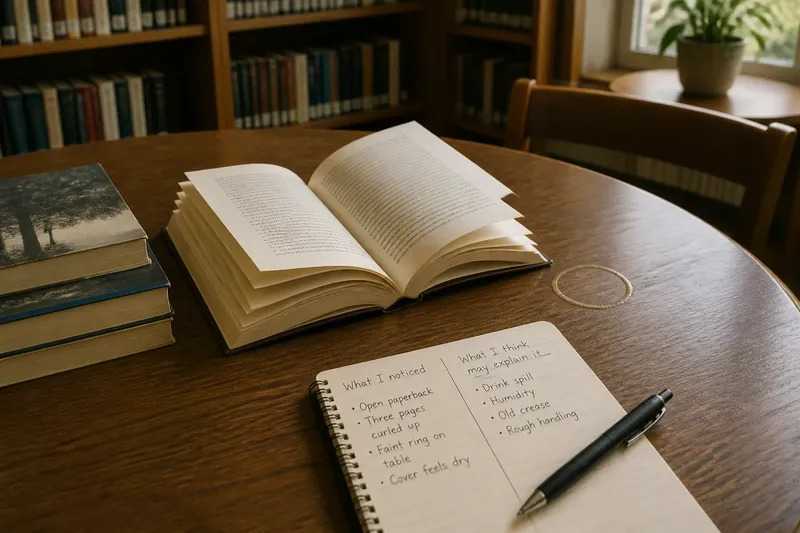
Write one visible detail and one separate question it raises. Keeping the question distinct from the observation leaves room to check it later.
A worked notebook page
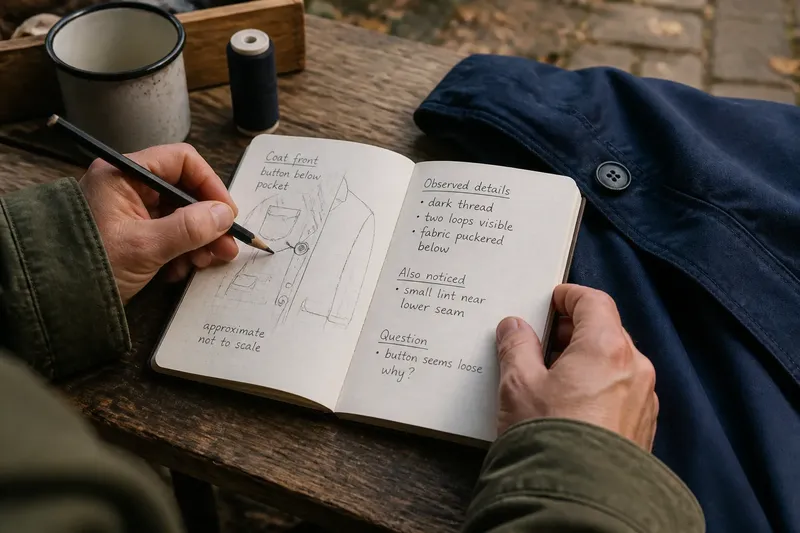
Say you notice a loose button on a coat at a neighborhood repair table. You have a pencil and a small notebook, and the useful question is where the button sits and what its thread looks like.
- Draw a quick outline of the coat front and mark the button below the pocket. The resulting sketch preserves its position without suggesting a measured scale.
- Write “dark thread; two loops visible; fabric puckered below” beside the drawing. These words preserve details that the outline would not show well.
- Add “button seems loose” as a separate note, rather than treating a guess about the cause as something visible. The page now records what you saw and what you may want to inspect again.
- On a later visit, add a new dated note if the button or fabric looks different. That makes the change easier to distinguish from the original observation.
The tradeoff is modest: a few extra words take longer than a bare sketch, but they make the thread and fabric details easier to recall. If those details do not matter to your question, the drawing alone may be enough.
Keep the page readable
Before closing the notebook, look at the page as if you had not been there. Can you tell what the drawing shows? Does each list item name its subject? If not, add a few clarifying words while the scene is still fresh.
For your next observation, choose the sketch or list that fits the detail you want to keep. A sketch or list is a record of what caught your eye, not an explanation of why it happened; let an unclear part point toward a question for another look.