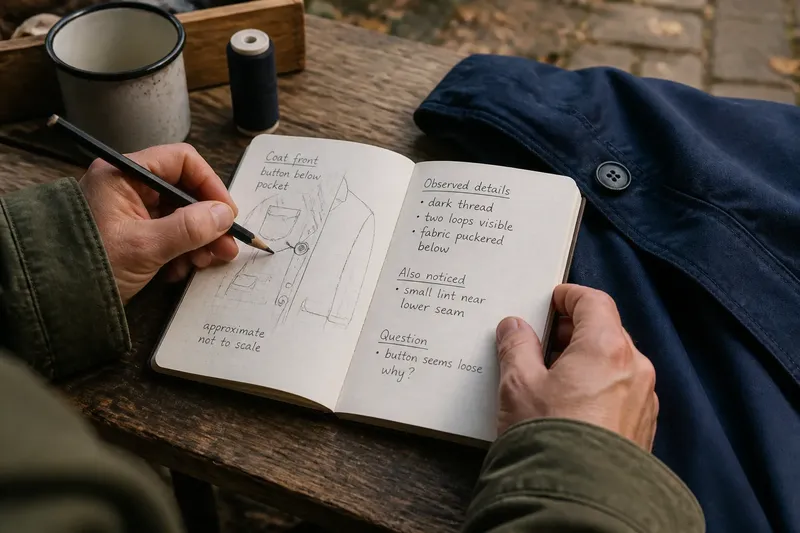
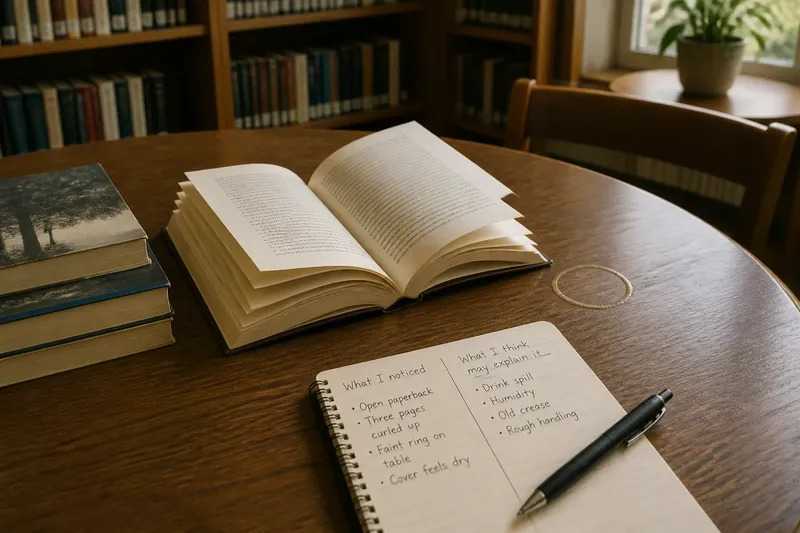
The Best Question Is Often Smaller Than the Topic
A smaller question turns broad curiosity into something you can answer: choose one object, notice a change, or compare two clear cases.

To narrow a question, choose one small feature of the thing that caught your attention. If you wonder why a houseplant looks uneven, ask whether one stem bends toward the window. That wording gives curiosity a clear subject without pretending to explain the cause.
Find the question inside
A broad topic can hide several different curiosities. “Old buildings” might mean their doorways, stonework, signs, or the way people use them. Rather than trying to account for the whole subject, pick the detail you would be pleased to understand a little better.
One useful prompt is: “What caught my eye, and what would I like to know about it?” The answer might be a brass handle worn smooth at its center, a row of mismatched roof tiles, or a patch of moss on a shaded wall. These details are not merely smaller topics; they are invitations to look more closely.
A good question acts like a bookmark in a book: it holds your place while you explore, without deciding what the whole story means.
Pick one anchor
Give your question one steady reference point. It could be a particular object, a visible change, or a comparison that makes you curious.
- Object: Choose one identifiable thing, such as a chipped blue mug or the maple leaf caught beside a curb.
- Change: Ask about a feature that shifts, such as where a shadow falls or how a bread crust darkens while baking.
- Comparison: Set two cases beside each other, such as a damp towel and a dry one, and ask what feels different.
Let the anchor determine the scope. If you are curious about a chair near a window, start with one detail, such as where its shadow falls, rather than folding the light, room temperature, furniture, and time of day into one question.
Sharpen the wording
Write a rough question, then replace words that could mean too many things. “How does the kitchen change?” might become “Where does the patch of sunlight fall on the kitchen floor in the morning?” The revised version points to a particular feature and leaves other changes aside.
Ask yourself what would count as an answer. If the question is “Which doorway is brighter?”, you might look at the light falling across the floor in each doorway. If “brighter” could mean something else to you, name the feature you actually want to compare, such as the sunlit area or the depth of the shade.
Use these decision checks before settling on the wording:
- If you can point to one object or two clear cases, keep that anchor; if you cannot, choose a specific object or comparison.
- If you can say what visible or audible feature matters, keep the wording; if not, replace a vague term such as “better” with a quality you can notice.
- If the answer depends on a place or moment you cannot access, change the setting; if you can reach it, keep the question within that setting.
- If one sentence contains two different things to find out, keep the one that interests you most; if it asks one clear thing, leave it intact.
- If you can imagine a tentative answer without explaining every cause, the scope is workable; if not, narrow the feature or comparison.
- If the wording leaves room for an unexpected result, keep it open; if it assumes a particular outcome, rewrite it as a question rather than a conclusion.
Questions to refine?
How narrow should a question be?
Narrow it until you can say what you would look for, but leave room for an unexpected answer. “Which spoon feels cooler, the metal one or the wooden one?” points to a direct comparison and still lets the result surprise you.
Can a question start with why?
It can, but “why” often asks for a cause that may be hard to distinguish from other possibilities. Start with what changes, where it happens, or how two cases differ, then decide whether you have enough to consider a cause.
What if I cannot answer it?
Check whether the question depends on access, time, or a feature you can actually notice. If it does, choose a reachable place or a more visible feature; if it does not, keep the question open and treat the answer as unresolved.
Can one question lead to another?
Yes. Noticing that a shadow reaches one part of a wall but not another might raise a new question about the window or time of day. Keep that as a separate inquiry so the original question stays clear.
A worked example
Say you notice that a basil plant on a kitchen windowsill looks lopsided. Your starting point is one plant and one visible feature: the direction of its longest stem. You first ask, “Why is the plant uneven?” That question could involve several features and possible causes, so you revise it to, “Does the longest stem point toward the window?”
You look at the stem from the same side of the pot on two occasions and notice that it points toward the glass both times. Your answer is: “In these observations, the longest stem points toward the window.” The result supports a description, not a cause. You might next ask whether the plant’s position relative to the window matters, but that is a new question rather than a conclusion hidden inside the first one.
When does a question change?
What if the detail changes?
If the feature you chose no longer holds your interest, write a new question about the detail that does. Keep the original wording separate so you can tell what you were asking before your attention shifted.
What if two details compete?
Choose the one you most want to understand first, and set the other aside. If the first question reveals a useful connection, make the second detail its own inquiry.
When should I keep looking?
Continue if another look could clarify the feature named in the question. If you already have a tentative description but still cannot explain its cause, treat that as a limit of this question rather than a reason to stretch its answer.
Keep the scope honest
A narrow question can make a detail easier to examine, but it does not make one observation explain everything around it. If a plant stem points toward a window, that describes its direction; it does not establish why it grew that way. Keep the question close to what it can actually address.
When a question grows too broad again, return to the detail that first caught your attention. For the best question is often smaller than the topic: it gives your curiosity a clear next place to look, while leaving room for another question later.