Before the Pocket Notebook: How Field Observations Were Kept
Explore how field observations were recorded before pocket notebooks, and learn what surviving marks on maps, letters, and objects can reveal.
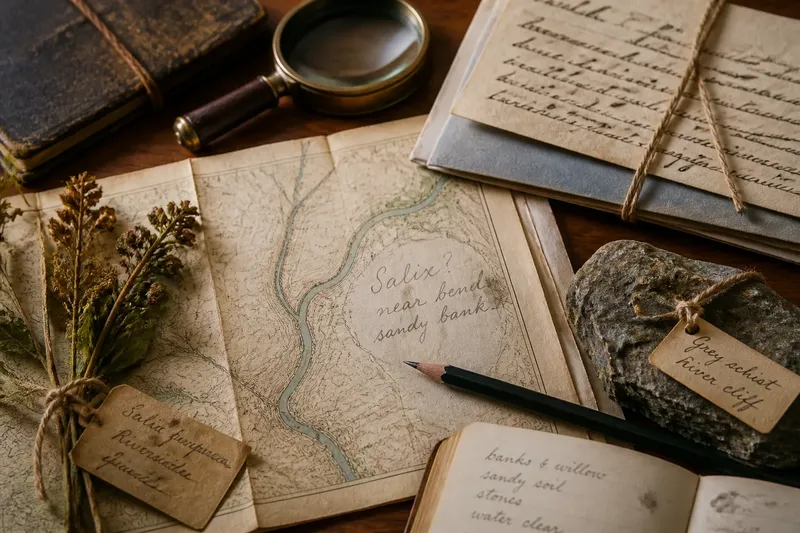
Field observations before pocket notebooks often survive not as tidy field journals but as marks attached to other work: a note on a map, a label tied to an object, or a description in a letter. The form matters because it can reveal what an observer needed to remember and where that record was meant to go next.
There is no single story of what people used before the pocket notebook. Writing tools, habits, and surviving records varied across places and periods. Rather than assume one standard substitute, it is more useful to look at the record itself: where the note appears, what it refers to, and whether it seems intended for immediate use or later reference.
Read the record’s setting
A note written in a margin has a different relationship to its subject than a tag tied to a collected object. A map annotation can connect a remark to a route or location; a label can keep an identification beside the thing it names. A letter may preserve observations as part of a message to another person, rather than as a standalone log.
These clues are suggestive, not conclusive. A note’s placement can tell you how it was used, but not always who made it or exactly when. Look for handwriting, ink or pencil, folds, stitching, labels, and references in surrounding text. Treat each clue as a question to investigate rather than proof of a complete story.
Follow the paper trail
When looking at an old record, start with its physical connections. Is the observation written on the same sheet as a route, a letter, or a list? Does a label remain attached to an object, or has it been stored separately? Does the wording point to a place, a person, or a later task?
Those relationships can explain why a record took its particular form. A loose sheet may have been convenient to file with a map. A brief annotation may have been enough to identify a location. A longer description in a letter may have been written for someone who needed more context. Avoid turning these possibilities into claims about what everyone did.
Imagine finding a handwritten plant name on a folded map, beside a path marked in pencil. You note the map’s title, the position of the writing, and the fact that no date appears beside it. The result is a careful description of what the object shows, while leaving open whether the name was added during the journey or later.
What can the marks tell you?
Does a margin note count as a field record?
It can preserve an observation, but its purpose depends on its setting and wording. Describe where it appears and what it refers to before deciding how it was used.
Can a label identify an object’s history?
A label may connect an object to a name, place, or collector, but it rarely answers every question by itself. Check whether the label remains attached and whether another record refers to the same wording or identifier.
How can I tell when a note was written?
Look for an explicit date and compare the note’s placement and handwriting with surrounding material, while recognizing that such clues may not settle the question. If the date is uncertain, describe it as uncertain instead of assigning one.
Why do some observations appear in letters?
A letter could carry an observation to another person along with explanation or a request. Its wording and audience may help clarify the note’s purpose, but they do not establish a universal practice.
Describe before interpreting
Separate visible features from conclusions. “Three lines in pencil beside the river bend” describes what is present. “The writer marked a collecting site” is an interpretation that may be plausible, but needs support from other clues.
A useful description records the object’s type, the note’s location on it, the visible wording, and any clear connection to a named place or item. If the writing is hard to read, say so. If a date is missing, do not supply one from guesswork.
- Check the medium: If the observation is on a map, letter, tag, or loose sheet, describe that item; if its form is unclear, record the uncertainty before assigning a category.
- Check the placement: If the note is attached to or beside a specific object or place, record that connection; if it is loose, avoid claiming a direct association without another clue.
- Check for a date: If a date is plainly written, transcribe it; if no date is visible, leave the timing unresolved rather than estimating it.
- Check the wording: If the text is legible, quote or transcribe only what can be read; if it is partly unclear, mark the unreadable portion instead of completing it by intuition.
- Check for a named person: If a signature or name appears, record it as written; if authorship is absent, do not attribute the note to a likely observer.
- Check related records: If another document clearly refers to the same object or wording, note the connection; if the match is only suggestive, describe it as a possibility.
Keep uncertainty visible
Old records invite a satisfying story: someone sees something, writes it down, and carries the note home. Sometimes that sequence may fit the evidence. Often, the record does not tell us whether the writing was made on the spot, copied later, or revised after a conversation.
That uncertainty is part of the record, not a flaw to hide. Preserve the original wording where possible, distinguish transcription from interpretation, and note what remains unknown. A simple analogy helps: a map margin is like a tab on a folder—it points toward a connection, but does not explain everything inside.
When you encounter field observations before pocket notebooks, look first at the record’s material setting and its links to other objects or documents. That approach makes the surviving evidence easier to understand without asking it to tell more than it can.